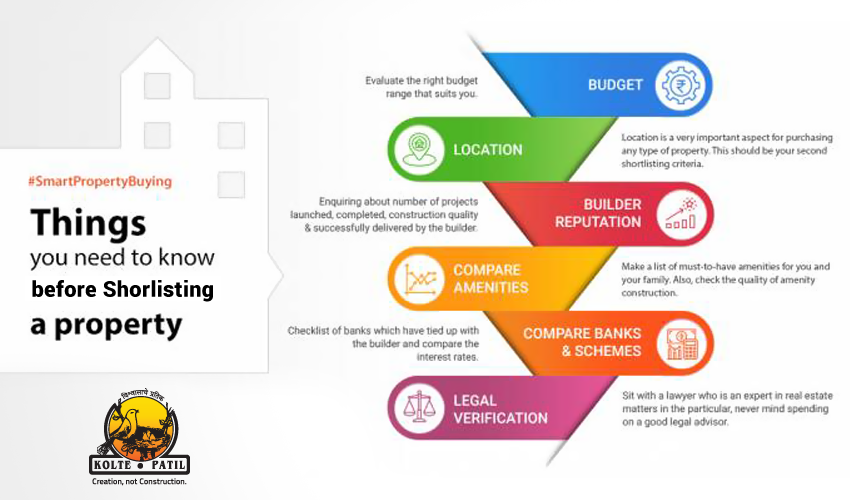
Things You Should Consider Before Shortlisting A Property
By Kolte-Patil Team | Last Updated: May 11, 2026
Key Takeaway
While we all dream of owning the perfect home, we are only too familiar with how overwhelming the search can be. Shortlisting a property is a critical step that requires careful evaluation of sever…
While we all dream of owning the perfect home, we are only too familiar with how overwhelming the search can be. Shortlisting a property is a critical step that requires careful evaluation of several factors. Here are the key things you should consider before making your final list.
If you’re looking to make a promising real estate investment, here are some things to consider before shortlisting a property.
1.The location:
Essentials of Shortlisting a Property
Location is all-important when it comes to property purchase. Whether you’re looking at a residential property or a commercial one, finding the right location is essential. The property should offer you quick and easy access to a wide range of social and civic amenities, such as schools, hospitals, employment hubs, shopping malls, multiplexes and convenience stores. Moreover, the roads and the public transit options should connect you to the rest of the city.
For location evaluation, it also helps to map out your expected daily commute to work, children’s schools, frequently visited healthcare facilities, and preferred shopping and leisure destinations. Comparing total travel time and traffic conditions across shortlisted properties gives a realistic picture of how each option will affect your time, fuel costs, and overall lifestyle once you actually move in and settle into routines.
2. The size and layout:
The size and layout of the property should meet your requirements. For this purpose, it is a good idea to start with a clear list of requirements. Make sure that the size, layout, storage options and indoor amenities and provisions are matched with your needs and preferences.
Alongside layout, pay attention to directional orientation, cross ventilation, natural light, and noise from external sources like arterial roads and railway lines. Homes that receive balanced sunlight and airflow tend to feel more pleasant through seasons, reduce dependence on artificial lighting and cooling, and support better long-term health and comfort for residents, particularly senior family members and young children spending longer hours indoors.
3. The amenities:
Budget, Location, and Builder Reputation
The amenities offered by the residential or commercial complex play an important role when you’re looking out for the ideal property. In a residential complex, for instance, look out for amenities like a swimming pool, gymnasium, clubhouse, play area, parks and gardens, parking facility and power backup.
While assessing amenities, also consider how well they are maintained in comparable older projects by the same developer. Brand-new facilities may look impressive during a site visit, but their real value depends on ongoing maintenance, association governance, and quality of staff. Ask to visit a handed-over project by the builder to see how lifts, gardens, clubhouses, and parking areas age over five or more years of community usage.
4. The neighbourhood:
It is essential to pick out a property that lies in a good neighbourhood. The neighbourhood should be safe and secure (with a low or zero crime rate) and the roads in the area should be well-maintained and well-lit.
When judging a neighbourhood, it also helps to check civic plans for the surrounding area, including proposed metro lines, road widening projects, new commercial zones, and upcoming social infrastructure. A neighbourhood that is improving on the civic front generally offers stronger appreciation potential than one that is fully developed with little further upside, especially for buyers approaching real estate as a combined lifestyle and investment decision.
5. The builder:
One of the most important things to keep in mind before shortlisting a property is to ensure that the builder is a reputed and trustworthy one with a good track record in the industry. This will ensure quality construction, timely delivery, safe and reliable transactions and excellent ROI.
Buyers should also evaluate a developer’s financial health, delivery history across multiple cycles, quality of past handover experiences, and responsiveness to resident associations after possession. A builder that shows consistency across these parameters is more likely to protect buyer interests, honour configuration commitments, and maintain common infrastructure well beyond handover, which ultimately preserves both the utility and resale value of the property over the long term.
Looking for the perfect home in Pune? Kolte-Patil Developers Ltd. presents variety of residential properties starting from 30 Lacs*
Explore more Kolte-Patil projects in Pune. Verify RERA registration details on the MahaRERA official website.
Frequently Asked Questions
What is Essentials of Shortlisting a Property?
Location is all-important when it comes to property purchase. Whether you’re looking at a residential property or a commercial one, finding the right location is essential. The property should offer you quick and easy access to a wide range of social and civic amenities, such as schools, hospitals, employment hubs, shopping malls, multiplexes and convenience stores. Moreover, the roads and the public transit options should connect you to the rest of the city. For location evaluation, it also h
What is Budget, Location, and Builder Reputation?
The amenities offered by the residential or commercial complex play an important role when you’re looking out for the ideal property. In a residential complex, for instance, look out for amenities like a swimming pool, gymnasium, clubhouse, play area, parks and gardens, parking facility and power backup. While assessing amenities, also consider how well they are maintained in comparable older projects by the same developer. Brand-new facilities may look impressive during a site visit, but thei