Living With Nature: Why Bhugaon Is Attracting Pune’s IT Professionals
By Kolte-Patil Team | Last Updated: September 1, 2026
Key Takeaway
Something changed in Pune's real estate map after 2020, and it never changed back. The pandemic didn't just send IT professionals home to work from their dining tables.
Something changed in Pune’s real estate map after 2020, and it never changed back. The pandemic didn’t just send IT professionals home to work from their dining tables. It rewired what they want from a home altogether. Space. Air. Silence. A view that isn’t another building’s bathroom window. And five years later, with hybrid work now the permanent reality for most tech companies operating out of Hinjewadi, Kharadi, and Magarpatta, the consequences are showing up in sales numbers that would have seemed absurd a decade ago.
Bhugaon, a locality tucked into the Sahyadri foothills along Paud Road in Pune’s western corridor, has emerged as one of the most talked-about residential pockets for this new generation of homebuyers. Not because of a flashy marketing campaign or a viral social media post, but because it solves a problem that central Pune simply cannot: how do you live close to nature and still reach your office in 20 minutes?
The answer, for a growing number of IT professionals in Pune, is Bhugaon. And the data backs them up. With an 88% absorption rate across active residential projects, demand here isn’t speculative. It’s structural. This is a market shift driven by people who’ve done the math on commute times, compared apartment sizes, checked air quality indices, and decided that trading a Baner address for a hill-view balcony and 300 extra square feet is not a compromise. It’s an upgrade.
Featured Snippet
Why are IT professionals moving to Bhugaon? Bhugaon offers Pune’s tech workforce a rare combination: a 20-25 minute commute to Hinjewadi IT Park via Paud Road, significantly larger apartment sizes compared to Baner or Wakad, panoramic Sahyadri hill views, and direct weekend access to trails at Tamhini Ghat and the Lavasa route. With an 88% project absorption rate and township developments like Kolte Patil The Winds offering 7.5 acres of green living, Bhugaon delivers the nature-integrated lifestyle that hybrid workers actively seek without sacrificing urban connectivity.
Key Takeaways
● Bhugaon sits just 20-25 minutes from Hinjewadi IT Park via the scenic Paud Road corridor, making it one of the most accessible green-living destinations for Pune’s tech professionals.
● The 88% absorption rate across Bhugaon residential projects signals genuine buyer demand, not developer speculation, driven by post-pandemic lifestyle priorities.
● Apartment sizes in Bhugaon typically offer 15-25% more carpet area compared to equivalent configurations in Baner, Wakad, or Hinjewadi, at significantly lower per-square-foot rates.
● Kolte Patil’s The Winds in Bhugaon spans 7.5 acres and delivers a township-scale lifestyle with hill views, open spaces, and modern amenities in 2 BHK and 3 BHK configurations.
● Weekend proximity to Tamhini Ghat (30 min), Mulshi Dam, and the Lavasa route transforms the daily living experience from driving to nature to living inside it.
● Upcoming infrastructure projects including the Pune Ring Road and western metro corridor are expected to further compress commute times and boost Bhugaon’s connectivity profile.
The Great Shift — Why Pune’s Tech Workforce Is Rethinking Where They Live
Let’s start with the uncomfortable truth that every IT professional in Pune already knows: the apartments most of them bought or rented in Baner, Wakad, and Hinjewadi between 2015 and 2020 were never designed for someone to also work from them. A 650-square-foot 2 BHK with a combined living-dining room, one bedroom repurposed as an office, a child doing online school at the kitchen counter, and conference calls competing with construction noise from the plot next door. That was the reality for tens of thousands of Pune’s tech workers when hybrid work became permanent.
Pune’s IT sector now employs over 800,000 professionals directly, with the broader ecosystem pushing past 1.2 million when you count ancillary services. The city has India’s second-largest IT corridor after Bengaluru. And according to multiple industry surveys conducted through 2025 and early 2026, between 65% and 72% of these professionals now work in hybrid models, with at least 2-3 days per week spent working from home. That’s not a temporary arrangement. It’s the permanent operating structure.
This single fact has redrawn the residential demand map. When you commute five days a week, proximity to your office building is everything, and you’ll tolerate a cramped apartment to get it. When you commute two or three days a week, the calculus flips. Suddenly, square footage matters more than pin code. A dedicated workspace matters more than being walking distance from a co-working cafe. And a balcony with a hill view matters more than a balcony overlooking a construction site.
The shift shows up clearly in real estate transaction data across Pune’s western corridor. Micro-markets along Paud Road, including Bhugaon, have seen a 34% year-over-year increase in inquiry volumes from buyers who identify as IT professionals, according to data aggregated from major property platforms in early 2026. Meanwhile, premium micro-markets in Baner and Wakad, while still active, are seeing longer sales cycles and increased negotiation on price, a sign that buyer urgency has migrated elsewhere.
Here’s the thing: this isn’t a rejection of convenience. It’s a redefinition of it. For a professional who works from home three days a week, convenience isn’t a 5-minute walk to a bus stop. Convenience is 1,200 square feet of living space with a separate room for work, fresh air on the balcony, a township jogging track visible from the window, and a 20-minute drive to the office on the days you do go in. That’s what Bhugaon delivers, and that’s why the demand curve is pointed in its direction.
Bhugaon — Pune’s Best-Kept Secret for Green Living
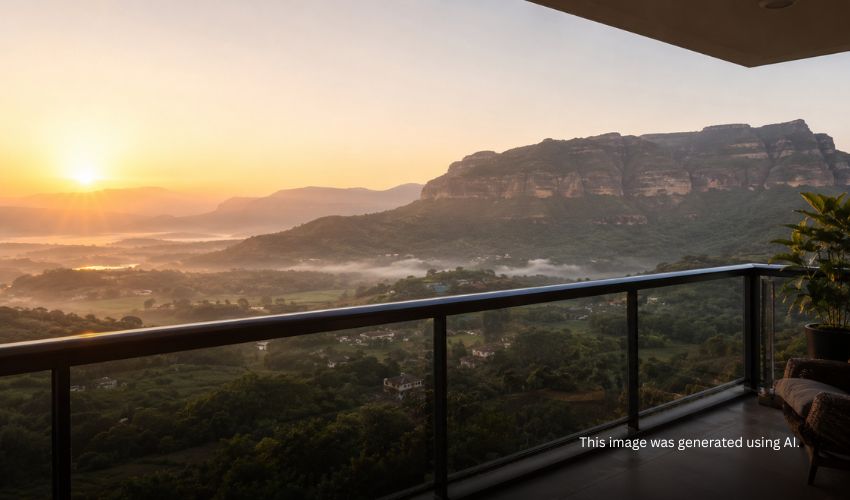
Bhugaon sits at the threshold where Pune stops being a city and starts becoming the Sahyadris. Located on the western edge of Pune along the Paud Road corridor, it occupies an elevated pocket of land flanked by hills on three sides, with views that stretch across forested ridgelines and seasonal streams. The elevation here sits noticeably higher than the Pune city basin, which translates directly into measurably cooler temperatures, lower humidity, and significantly better air quality.
If you’ve driven Paud Road on a weekend morning, you’ve probably felt the shift. Somewhere past Kothrud, the density drops. The building heights reduce. Trees start outnumbering billboards. By the time you reach Bhugaon, you’re looking at a landscape that feels closer to a hill station approach road than a Pune suburb. That’s not a poetic exaggeration. It’s a geographic reality that stems from Bhugaon’s position at the foot of the Western Ghats, one of the world’s eight biodiversity hotspots.
Air quality data tells a compelling story. While central Pune localities like Shivajinagar and Deccan regularly record AQI readings between 120 and 180 during winter months, and Hinjewadi hovers around 100-140, stations near Bhugaon and the Paud Road corridor consistently report readings between 40 and 75, often falling into the ‘Good’ category. For families with children, for professionals spending 8-10 hours a day inside their homes, and for anyone who’s spent a winter morning in Kothrud coughing through smog, those numbers aren’t trivial. They’re a quality-of-life metric that no amount of interior design can replicate.
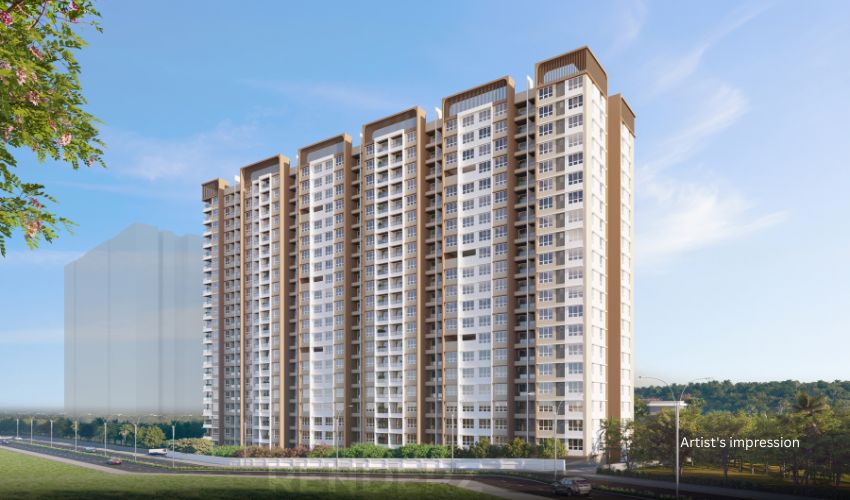
It’s within this setting that Kolte Patil has developed The Winds, a 7.5-acre integrated township that uses the topography rather than fighting it. The project is designed to maximize exposure to the surrounding hills, with building orientations calibrated for unobstructed views from most upper-floor units. The township includes landscaped open spaces that flow with the natural gradient of the land, walking trails that connect to the broader Bhugaon landscape, and a clubhouse positioned to frame the western hill views.
The Winds isn’t trying to be a gated island of greenery in an otherwise concrete locality. It’s designed to be an extension of the natural environment it sits in. That’s a distinction worth noting, because most township projects in Pune create green spaces as amenities, isolated from the surroundings. Here, the surroundings are the amenity. Step outside the township boundary and you’re on trails. Look out from your balcony and you’re watching sunset shadows move across real hills, not painted murals on a compound wall.
Township amenities at The Winds include a fully equipped clubhouse, swimming pool, children’s play zones, multi-purpose courts, a dedicated senior citizen area, landscaped gardens, and indoor recreational facilities. These are standard for a project of this scale, but what makes them different here is the backdrop. Every outdoor amenity benefits from the elevation, the breeze, and the views. A morning jog on the township track here isn’t an exercise in dodging traffic noise. It’s exercise with a view of the Sahyadris.
20 Minutes to Hinjewadi, A World Away From the Chaos
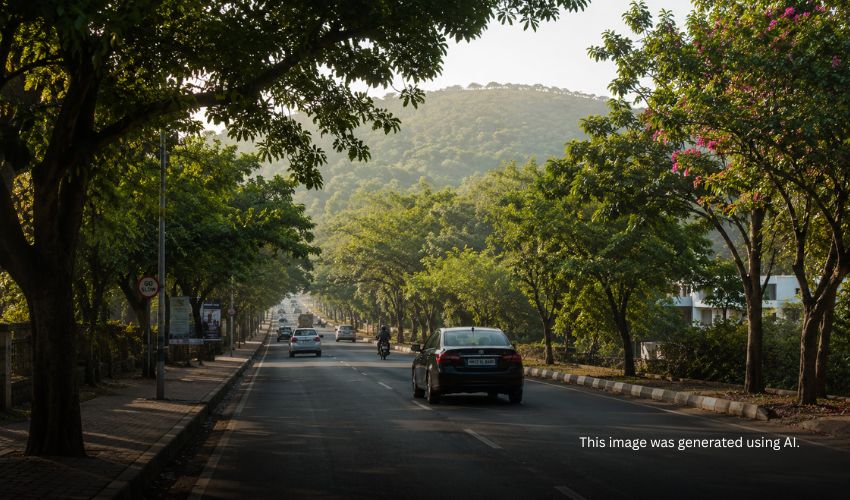
Now compare that with commute times from the localities that IT professionals traditionally flock to. Baner to Hinjewadi Phase 1, on paper roughly 8-10 kilometers, routinely takes 35-50 minutes during morning peak hours. Wakad, which is even closer on the map, delivers 25-40 minutes depending on which internal road you take and whether the Dange Chowk signal is in one of its hostile moods. The Balewadi-Hinjewadi stretch, a distance your GPS will tell you is 6 kilometers, regularly consumes 30+ minutes in bumper-to-bumper traffic.
The difference is traffic density, and this is where Bhugaon holds a structural advantage. The Paud Road corridor carries a fraction of the vehicular load that the Baner-Balewadi-Wakad corridor handles. There are fewer intersections, fewer commercial establishments generating stop-start traffic, and fewer competing residential towers emptying thousands of cars onto the same road at the same time every morning. The result is a commute that’s not just faster on paper but more predictable. You know how long it will take, every day. That matters when you’re planning your life around hybrid work schedules.
Infrastructure improvements currently underway will further strengthen this connectivity. The proposed Pune Ring Road, which has received formal approval and is in the land acquisition phase along the western corridor, will create a high-speed bypass connecting Bhugaon directly to the Mumbai-Bangalore Highway and from there to Hinjewadi, without passing through any of the congested inner-city junctions. When this link comes online, estimated within the next 3-4 years, commute times from Bhugaon to Hinjewadi are projected to drop below 15 minutes.
Connectivity isn’t limited to Hinjewadi, either. Bhugaon residents are 15 minutes from Kothrud, one of Pune’s most established residential and commercial localities. Deccan Gymkhana, FC Road, and JM Road, the cultural and retail heart of Pune, are roughly 25-30 minutes away. The Chandani Chowk junction, which connects to the expressway network leading to Pune Station and the eastern industrial corridor, is a 10-minute drive. What you trade by choosing Bhugaon isn’t access. It’s noise.
Weekend Trails, Not Weekend Traffic — The Bhugaon Lifestyle Advantage

Now ask someone living in Bhugaon the same question. The Tamhini Ghat viewpoint is 30 minutes away. The Mulshi Dam approach road is about 35 minutes. The old Lavasa access route, popular with cyclists and weekend explorers, starts practically at the edge of the Bhugaon residential zone. Paud village, with its historical sites and rural weekend breakfast joints, is 15 minutes down the road. You don’t need to plan a nature trip. You step outside and you’re already there.
Cycling has become a particularly strong part of Bhugaon’s identity. Paud Road is already one of the most popular cycling routes in Pune, used by recreational riders, serious amateur groups, and professional training squads. The road’s gradient, its relatively low traffic density compared to Sinhagad Road or the Katraj stretch, and the scenic quality of the ride make it an almost perfect urban-to-rural cycling corridor. For residents of The Winds, a weekend morning ride doesn’t require loading the bike onto a car rack and driving somewhere. It starts at the front gate.
Morning treks are another routine, not event, for Bhugaon residents. The surrounding hills offer multiple trail options ranging from gentle 30-minute walks along ridge lines to moderately challenging 2-hour loops that take you through forested slopes. These aren’t curated, ticketed trekking experiences. They’re neighborhood walks that happen to go through genuinely beautiful terrain. Families with children, couples with dogs, solo walkers with earphones and podcasts, retired residents with early-morning energy: the trails see all of them regularly.
The psychological difference between living near nature and living in nature is significant and underappreciated. When you live in Baner and visit Lonavala once a month, nature is a break from your real life. When you live in Bhugaon and see hills from your balcony every morning, hear birds instead of honking during your work calls, and walk a forest trail before dinner, nature is your real life. That’s not a lifestyle upgrade. It’s a lifestyle category change. And for the generation of IT professionals who spent 2020-2021 locked in cramped apartments realizing they wanted something fundamentally different, that category change is exactly what they’re looking for.
The Numbers Don’t Lie — Why Bhugaon Property Demand Is Surging
Lifestyle appeal is one thing. Market data is another. And in Bhugaon’s case, the data is emphatically confirming what the lifestyle pitch promises. The absorption rate across active residential projects in Bhugaon currently sits at approximately 88%. That’s a remarkable number in any market context, and it puts Bhugaon among the top-performing micro-markets in Pune’s western corridor.
To put that in perspective: a healthy absorption rate in Pune’s residential market is generally considered to be anything above 65-70%. Markets in the 75-85% range are classified as strong. Above 85% signals a demand-supply gap, meaning buyers are absorbing inventory faster than developers can add it. Bhugaon at 88% isn’t just strong. It suggests undersupply relative to demand, which has direct implications for future price appreciation.
Let’s break down the price comparison, because this is where the value proposition becomes concrete:
| Locality | Avg. Rate (Rs/sq ft) | Typical 2 BHK Size (sq ft) | Typical 3 BHK Size (sq ft) | Commute to Hinjewadi |
| Bhugaon | 5,500 – 7,200 | 850 – 1,000 | 1,200 – 1,500 | 20-25 min |
| Baner | 9,500 – 14,000 | 650 – 800 | 950 – 1,200 | 35-50 min |
| Wakad | 8,000 – 11,500 | 680 – 820 | 1,000 – 1,250 | 25-40 min |
| Hinjewadi | 7,500 – 10,500 | 620 – 780 | 900 – 1,150 | 5-15 min |
| Kothrud | 10,000 – 15,000 | 600 – 750 | 900 – 1,100 | 30-45 min |
The arithmetic is straightforward. A 3 BHK in Bhugaon at Rs 6,500 per square foot for 1,300 square feet costs approximately Rs 84.5 lakhs. A comparable configuration in Baner, where 1,100 square feet at Rs 12,000 per square foot is standard, costs Rs 1.32 crores. You’re paying 56% more in Baner for an apartment that’s 15% smaller, with a longer commute and no hill views. When you present that math to an IT professional earning Rs 25-40 lakhs per annum and making a data-driven purchase decision, the outcome is predictable.
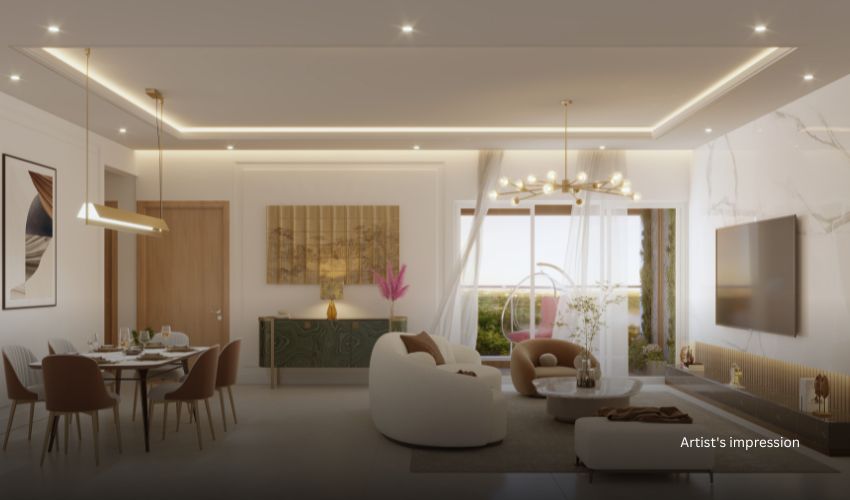
Kolte Patil’s The Winds Phase 1B is positioned within this value zone with 2 BHK and 3 BHK configurations designed specifically for the buyer profile Bhugaon attracts. The 2 BHK units offer spacious layouts that accommodate a dedicated work-from-home corner, something that buyers are now explicitly asking for during site visits. The 3 BHK units deliver the full hybrid-work package: a separate room that functions as a home office, generous balcony space with hill views, and living areas sized for families who actually spend most of their time at home.
From an investment perspective, Bhugaon’s trajectory mirrors what early buyers in Baner experienced between 2008 and 2015, when that micro-market evolved from a quiet suburb to one of Pune’s premium addresses. Price appreciation in Bhugaon over the past three years has averaged 12-16% annually, outpacing most established micro-markets in the city. With infrastructure developments like the Ring Road adding structural support to this growth curve, the case for capital appreciation is backed by fundamentals, not just sentiment.
What IT Professionals Are Actually Looking For in 2026
Buyer expectations have evolved faster than most developers have adjusted. The 2026 homebuyer in Pune’s IT corridor is not the same person who bought their first flat in 2018. Their priorities have shifted in specific, measurable ways, and understanding these shifts explains why Bhugaon and projects like The Winds are capturing market share.
Home office space is non-negotiable. Not a desk in the bedroom. Not a folding table in the living room. A dedicated space with a door that closes, room for a monitor setup, adequate lighting, and enough separation from the household’s daily activity to take video calls without a child appearing on screen. Surveys of Pune IT homebuyers conducted in 2025-26 consistently rank ‘dedicated workspace’ in the top three purchase criteria, ahead of parking, clubhouse access, and even proximity to schools.
Balcony and outdoor space preferences have increased dramatically. When you work from home, the balcony isn’t a place to dry clothes. It’s your decompression zone, your coffee break space, your visual connection to the outside world during eight hours of screen time. Buyers now evaluate balcony views with the same seriousness they once reserved for kitchen layout. In Bhugaon, where balconies face actual hills and greenery rather than neighboring towers, this preference translates directly into purchase decisions.
Community amenities are being re-evaluated through a work-from-home lens. The co-working space or business lounge within a residential complex has moved from a ‘nice to have’ to a frequently used facility. Parents want quality children’s zones because the kids are home more often. Fitness facilities matter more when your commute no longer includes a walk from the parking lot. And community spaces, gardens, seating areas, amphitheatres, are valued higher by people who spend most of their week within the township boundaries.
Air quality and mental health connections are now part of the buying conversation. This is perhaps the most significant shift. Five years ago, no one asked about AQI during a site visit. Now, informed buyers bring it up. They’ve read the studies linking prolonged exposure to urban air pollution with respiratory issues, reduced cognitive performance, and increased stress markers. They understand that working from home in a locality with consistently good air quality isn’t just a preference; it’s a productivity and health investment.
The Winds township at Bhugaon aligns with these evolved expectations in ways that aren’t accidental but architectural. The layouts allocate space for work zones. The balconies are sized and oriented for views, not just ventilation. The township design incorporates community and fitness infrastructure at a scale that assumes residents will use it daily, not occasionally. And the location itself, nestled in the foothills with consistently clean air, delivers the environmental quality that central-Pune alternatives simply cannot match.
Bhugaon vs Baner vs Wakad — An Honest Comparison
Comparing localities requires honesty about trade-offs. Bhugaon isn’t perfect for everyone, and Baner still has advantages for certain buyer profiles. Here’s the side-by-side view:
| Parameter | Bhugaon | Baner | Wakad |
| Price per sq ft (avg) | Rs 5,500 – 7,200 | Rs 9,500 – 14,000 | Rs 8,000 – 11,500 |
| 2 BHK typical size | 850 – 1,000 sq ft | 650 – 800 sq ft | 680 – 820 sq ft |
| 3 BHK typical size | 1,200 – 1,500 sq ft | 950 – 1,200 sq ft | 1,000 – 1,250 sq ft |
| Commute to Hinjewadi | 20-25 minutes | 35-50 minutes | 25-40 minutes |
| Green cover | Extensive (Sahyadri foothills) | Limited (urban pockets) | Minimal (fully urbanized) |
| Air quality (avg AQI) | 40-75 (Good) | 90-130 (Moderate) | 95-140 (Moderate-Poor) |
| Traffic congestion | Low | High to severe | Moderate to high |
| Weekend nature access | Immediate (trails at doorstep) | 60-90 min drive | 45-75 min drive |
| Social infrastructure | Developing (schools, retail) | Fully established | Well established |
| Restaurant/retail density | Growing (Paud Road corridor) | High | High |
| Public transit | Limited (bus routes) | Good (metro planned) | Moderate (metro planned) |
| Investment appreciation | 12-16% annually | 6-8% annually | 7-9% annually |
| Township options | Multiple (incl. 7.5-acre The Winds) | Limited large-scale | Few township-scale projects |
| Noise levels | Low | High | Moderate to high |
Where Baner wins: social infrastructure maturity, restaurant and retail density, public transit access, and the convenience of being inside the established urban fabric. If your lifestyle requires walking to a multiplex, having 15 restaurant options within a kilometer, or relying on public transit, Baner serves that profile better.
Where Bhugaon wins: space, price, air quality, nature access, commute predictability, investment appreciation potential, and the overall living environment. If your lifestyle prioritizes a spacious home with a view, outdoor access for fitness and recreation, and a stress-free commute, Bhugaon delivers measurably more than its competitors.
The honest assessment: Bhugaon is not for buyers who need to be in the middle of everything at all times. It’s for buyers who’ve been in the middle of everything and have decided they want something different. That buyer profile is growing rapidly, and Bhugaon is where they’re going.
FAQ’s
1. Is Bhugaon a good place to live in Pune?
Bhugaon is an excellent choice for families and professionals who prioritize green living, clean air, and spacious homes. Located along Paud Road in Pune’s western corridor, it offers Sahyadri hill views, proximity to nature trails, a 20-25 minute commute to Hinjewadi, and significantly lower property rates compared to Baner or Kothrud. The 88% absorption rate in active projects confirms strong buyer confidence.
2. How far is Bhugaon from Hinjewadi IT Park?
Bhugaon is approximately 18-22 kilometers from Hinjewadi IT Park Phase 1, with a typical commute time of 20-25 minutes via the Paud Road and Chandani Chowk route during morning peak hours. Off-peak travel can be as quick as 18 minutes. This is comparable to or faster than commute times from Baner (35-50 min) despite Baner being geographically closer.
3. What is the property rate in Bhugaon Pune?
Property rates in Bhugaon currently range from Rs 5,500 to Rs 7,200 per square foot depending on the project, configuration, and floor level. This represents a 35-50% discount compared to Baner (Rs 9,500-14,000/sq ft) and 25-40% savings over Wakad (Rs 8,000-11,500/sq ft), while offering larger apartment sizes and superior natural surroundings.
4. Is Bhugaon well connected to Pune city?
Yes. Bhugaon connects to central Pune via Paud Road, reaching Kothrud in 15 minutes, Deccan Gymkhana in 25-30 minutes, and Chandani Chowk junction (expressway access) in 10 minutes. The upcoming Pune Ring Road will further enhance connectivity with a direct high-speed link to the Mumbai-Bangalore Highway corridor.
5. Why are IT professionals moving to Bhugaon?
The shift to hybrid work has changed buyer priorities. IT professionals now value spacious homes with dedicated workspaces, clean air, and nature access over proximity to the office. Bhugaon offers all three along with a 20-minute commute to Hinjewadi, making it an optimal choice for the work-from-home generation that commutes only 2-3 days per week.
6. What is Kolte Patil The Winds Bhugaon?
The Winds is Kolte Patil Developers’ flagship township project in Bhugaon, spread across 7.5 acres. It offers 2 BHK and 3 BHK apartments with panoramic Sahyadri hill views, a fully equipped clubhouse, swimming pool, landscaped gardens, children’s play areas, and multi-purpose sports facilities. Phase 1B is currently open for booking.
7. Is Bhugaon better than Baner for homebuyers?
It depends on your priorities. Bhugaon offers better value per square foot, larger apartments, cleaner air, nature access, and a faster Hinjewadi commute. Baner offers superior social infrastructure, retail density, nightlife, and public transit. For IT professionals prioritizing space, nature, and long-term investment returns, Bhugaon outperforms Baner on most metrics.
8. What are the best residential projects in Bhugaon?
Kolte Patil The Winds is one of Bhugaon’s most prominent township projects, offering 7.5 acres of integrated living with hill views. Other notable projects in the Bhugaon-Paud Road corridor include developments by established Pune developers. The area’s 88% absorption rate indicates that quality projects here are selling rapidly.
9. Does Bhugaon have good schools and hospitals nearby?
Bhugaon’s social infrastructure is developing. Schools along the Paud Road corridor serve the area, with established institutions in Kothrud accessible within 15 minutes. Healthcare facilities including hospitals and clinics in Kothrud and Warje are 15-20 minutes away. As the locality matures, more social infrastructure is expected to develop locally.
10. What is the future growth potential of Bhugaon Pune?
Bhugaon’s growth potential is supported by the upcoming Pune Ring Road (direct highway access), planned metro corridor extensions in the western zone, increasing IT workforce migration from central Pune, and consistent 12-16% annual appreciation rates. Analysts compare its trajectory to Baner’s 2008-2015 growth phase, suggesting significant upside for early buyers.