
Rent vs Buy in 2026: Why Owning a Home on Sinhgad Road Makes More Financial Sense
By Kolte-Patil Team | Last Updated: August 13, 2026
Key Takeaway
Every year you renew a rent agreement, your landlord’s asset grows and yours doesn’t. That is the whole rent vs buy debate in one sentence.
Every year you renew a rent agreement, your landlord’s asset grows and yours doesn’t. That is the whole rent vs buy debate in one sentence. The details, though, decide whether 2026 is your year to switch sides, and in Pune, few places make the arithmetic as interesting as Sinhgad Road.
This guide runs the actual numbers. Rent outflow against EMIs, tax benefits under current rules, what a decade of price trends in this corridor says about appreciation, and the honest cases where renting still wins.
Is It Better to Rent or Buy a House in Pune in 2026?
For most families planning to stay in Pune five years or longer, buying now has the stronger financial case. Three things tilt the scale in 2026.
First, rents have climbed sharply across Pune’s employment belts. Anyone renting near Hinjewadi, Kothrud, Karve Nagar or Warje has felt the annual revision. A standard lease builds in a 5 to 10 percent escalation, and in high-demand pockets landlords have pushed harder than that. Rent is the only major household expense that is designed to increase every year.
Second, home loan rates have settled into a borrower-friendly range of roughly 8 to 8.5 percent, which keeps EMIs predictable. A fixed obligation against a rising one: that gap compounds quietly in the buyer’s favour every single year.
Third, prices in growth corridors are not waiting. Price-trend data for Sinhgad Road on 99acres shows consistent appreciation over the past decade, with a distinct upswing heading into 2026. Postponing a purchase in a rising micro-market usually costs more than a year of rent.

Rent vs EMI on Sinhgad Road: What Do the Numbers Say?
Let’s make this concrete with a typical Sinhgad Road scenario.
A well-maintained 2 BHK in the Vadgaon Budruk to Dhayari stretch typically rents in the range of Rs 20,000 to 28,000 a month, with a 3 BHK going for Rs 30,000 to 40,000. Now look at ownership. On a Rs 60 lakh home loan at 8.5 percent over 20 years, the EMI works out to roughly Rs 52,000 a month. On a Rs 40 lakh loan, about Rs 34,700.
At first glance renting looks cheaper. The comparison changes when you add three factors:
1. Escalation. Rs 25,000 rent growing at just 5 percent a year totals nearly Rs 99 lakh over 20 years, and you own nothing at the end of it. The EMI, by contrast, ends with a fully owned asset.
2. Tax savings. Home loan deductions (detailed below) effectively reduce the real cost of the EMI for eligible borrowers.
3. Appreciation. Every year of ownership in an appreciating corridor adds equity. Every year of renting in that same corridor raises the entry price for when you finally buy.
| Renting (20 yrs) | Buying (20 yrs) | |
| Monthly outgo (start) | Rs 25,000 | Rs 52,000 (Rs 60L loan) |
| Annual increase | 5-10% escalation | None on EMI |
| Total outflow | ~Rs 99 lakh+ | EMI total, minus tax savings |
| Asset at the end | Nil | Fully owned home + appreciation |
| Stability | 11-month cycles, landlord’s terms | Yours, permanently |
The crossover point arrives faster than most tenants expect, usually within the first third of the loan tenure in a corridor where both rents and prices are rising.
What Are the Home Loan Tax Benefits in 2026?
Under the old tax regime, home buyers can currently claim deduction of up to Rs 1.5 lakh a year on principal repayment under Section 80C, and up to Rs 2 lakh a year on home loan interest for a self-occupied property under Section 24(b). Stamp duty and registration charges also qualify under 80C in the year of purchase.
Two practical notes. The new tax regime does not offer these deductions on a self-occupied home, so the right regime depends on your overall income structure; a chartered accountant can settle that in one sitting. And if the property is let out, interest can be set off against rental income under either regime, which matters for buyers picking up a second home as an investment.
Either way, a renter gets none of this. HRA exemption helps salaried tenants, but it shrinks in value against the combined effect of deductions plus equity plus appreciation.
Why Is Sinhgad Road One of Pune’s Smartest Places to Buy?
Location decides whether the buy side of this equation actually performs. Sinhgad Road’s case is unusually well-rounded, and we covered the corridor in depth in our Sinhgad Road location guide. The short version:

• Infrastructure ahead: the proposed Pune Ring Road, planned metro connectivity and the widening of the Sinhgad Road corridor itself are all set to compress travel times across West and South Pune.
• Mature social fabric today: DMart at Nanded City, Abhiruchi Mall, Sinhgad College, Orchids The International School, Sinhgad Hospital and Deenanath Mangeshkar Hospital are already in daily-use distance. This is not a promise-of-future-development locality; it functions now.
• Nature that cannot be replicated: Khadakwasla Dam twenty minutes away, NDA hills on the horizon. Neighbouring Kothrud and Karve Nagar are built out, making land parcels in this area among the last available within city limits.
• Price headroom: rates remain meaningfully lower than Kothrud or Baner for comparable inventory, which is precisely what gives the corridor its appreciation runway.
When Does Renting Still Make Sense?
An honest comparison names the exceptions. Renting remains the smarter call if your job could move you out of Pune within two or three years, if your savings would be fully drained by the down payment leaving no emergency buffer, or if you are still choosing between micro-markets and want a year of living in one before committing. Buying rewards a five-year-plus horizon. Shorter than that, transaction costs eat the gains.
If none of those describe you, the case for waiting gets thin. The one argument tenants lean on, “I will buy when I have saved more,” tends to fail in appreciating corridors because prices outrun savings.
What Should First-Time Buyers on Sinhgad Road Check Before Buying?
A short, practical list:
1. MahaRERA registration. Every under-construction project must be registered; verify the number on maharera.mahaonline.gov.in before paying a rupee.
2. Carpet area, not built-up. Compare homes on RERA carpet area only.
3. Developer delivery record. Ask how many projects the builder has delivered in Pune and on what timelines. A 35-year, 68-project record reads very differently from a first-time developer’s brochure.
4. Total cost of ownership. Factor stamp duty, registration, GST where applicable, society charges and interiors into the budget, not just the ticket price.
5. Run your own EMI maths. Use the Kolte-Patil EMI calculator to test loan amounts against your monthly comfort before shortlisting.
Where Does The Reserve Fit Into This Decision?
If the numbers have moved you from “should I buy” to “what should I buy,” Sinhgad Road’s newest answer is The Reserve by Kolte-Patil, a 21-acre master development at Vadgaon Budruk, Sinhgad Road with 2 and 3 bed residences, lush greens, NDA hill views and a central landscaped boulevard.
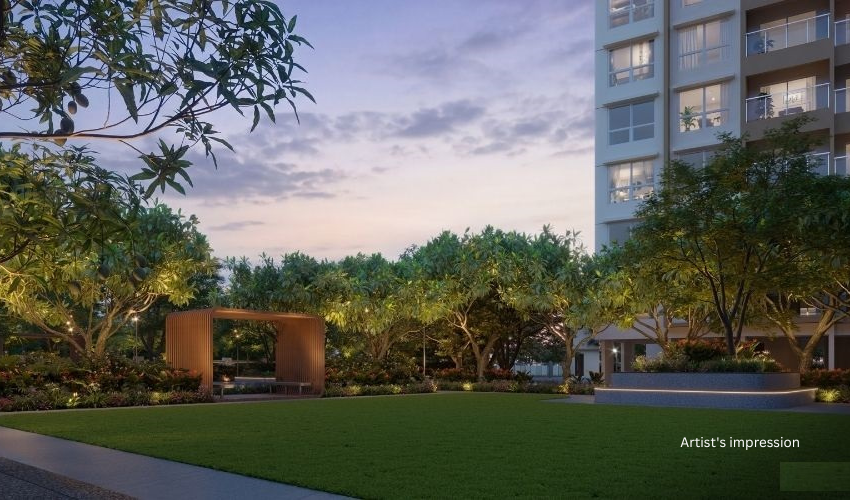
It is a useful benchmark for the rent vs buy exercise for one reason: scale. Buying into a corridor early is good; buying into the corridor’s most limited asset type is better. Buyers comparing 2 BHK flats in Pune or 3 BHK flats in Pune will find the configuration mix here built around exactly the family profile this article describes: people ready to convert rent into ownership without leaving the city’s conveniences behind.
The Takeaway
Rent buys you time. Ownership buys you an asset, tax efficiency and a fixed monthly cost in a city where rents only move one way. In 2026, with lending rates steady, prices in motion and Sinhgad Road’s infrastructure story compounding, the arithmetic leans clearly toward buying for anyone with a five-year horizon.
The most expensive line in any family budget is often the one that looks smallest: this year’s rent, renewed one more time.
Ready to see what your rent could own? Explore 2 and 3 bed residences at The Reserve on Sinhgad Road, or talk to our team at 1800 266 2233 for a no-pressure cost comparison built on your numbers.
Disclaimer: Tax benefits are subject to prevailing laws and individual eligibility; consult a tax advisor. Loan figures are indicative examples, not offers.
FAQ’s
1. Is it better to rent or buy a flat in Pune in 2026?
For a stay of five years or more, buying generally works out better in 2026. Rents in Pune rise 5 to 10 percent annually while EMIs stay fixed, and buyers gain tax deductions and price appreciation. Renting suits shorter, uncertain timelines.
2. What is the average rent for a 2 BHK on Sinhgad Road Pune?
A 2 BHK on Sinhgad Road typically rents between Rs 20,000 and 28,000 a month depending on the project, floor and furnishing, with 3 BHK homes ranging from about Rs 30,000 to 40,000.
3. How much EMI do I pay on a Rs 60 lakh home loan?
At around 8.5 percent interest over 20 years, a Rs 60 lakh home loan works out to an EMI of roughly Rs 52,000 a month. A shorter tenure raises the EMI but cuts total interest significantly.
4. What tax benefits do home buyers get in India in 2026?
Under the old tax regime: up to Rs 1.5 lakh a year on principal under Section 80C and up to Rs 2 lakh a year on interest under Section 24(b) for self-occupied homes. Stamp duty and registration also qualify under 80C in the purchase year.
5. Is Sinhgad Road a good place to buy property in Pune?
Yes. Sinhgad Road combines established schools, hospitals and retail with major upcoming infrastructure like the proposed Ring Road and metro connectivity, at prices below neighbouring Kothrud, giving it strong appreciation potential.
6. Which are the best new residential projects on Sinhgad Road?
The Reserve by Kolte-Patil at Vadgaon Budruk is the corridor’s newest landmark launch: 21 acres, a prime location, NDA hill views, 2 and 3 bed residences, MahaRERA registered (PM1261012600748).
7. How much do flats on Sinhgad Road cost compared to Kothrud?
Sinhgad Road rates remain meaningfully lower than Kothrud for comparable new inventory, which is a key reason buyers priced out of Kothrud and Karve Nagar are moving one corridor south without losing connectivity.
8. What is the minimum down payment for a home loan in India?
Lenders typically finance 75 to 90 percent of property value depending on ticket size, so buyers should plan a down payment of 10 to 25 percent plus stamp duty and registration costs.
9. Does rent increase every year in Pune?
Yes. Standard Pune lease agreements build in a 5 to 10 percent annual escalation, and renewals in high-demand areas near IT hubs often exceed that.
10. Should I buy an under-construction or ready possession flat in Pune?
Under-construction homes in RERA-registered projects usually cost less per square foot and offer better choice, while ready homes save rent immediately and carry no GST. The right pick depends on your rent outflow, timeline and cash flow.